Historic London pubs
This is a preview of the new Historic London Pubs setup. As the remaining pubs are added they will appear on the map and list below.
Explore the historic London pubs map








Browse the historic London pubs
City of London

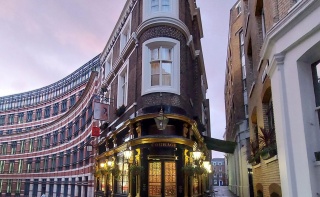
The Black Friar
174 Queen Victoria St, City of London, EC4V 4EG
For hundreds of years, throughout the medieval period, the Dominican friary in the south-west corner of the City was one of London’s most important religious houses, home to the ‘black friars’, named because of the black habits they wore. The friary, along with all monasteries, was dissolved by Henry VIII in the 1530s. Three hundred and fifty years later the Black Friar pub was built on a small part of the site of the friary. In the early 20th century it was remodelled with one of the most unique and interesting interiors of any London pub. You can learn more in my video here.
The Cockpit
7 St Andrew’s Hill, London, EC4V 5BY
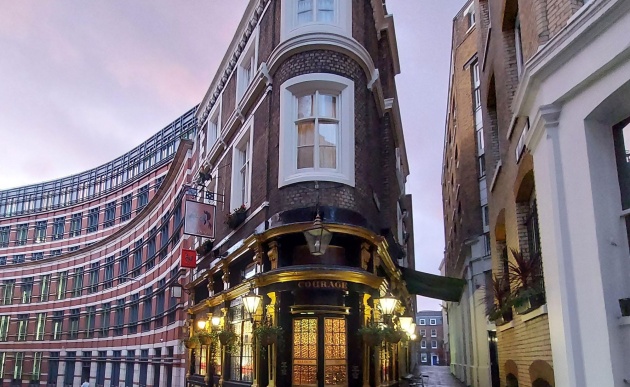
The Blackfriars district of London was in the Middle Ages an important priory, which was dissolved by Henry VIII. A gate into the priory was where the Cockpit pub is now located. We know this because in 1613 William Shakespeare and several associates purchased the former gatehouse. By that time cockfighting was taking place there, and in the late 18th century the Cock Pit tavern opened. The blood sport was banned in 1849 and the tavern became The Three Castles (presumably one being the nearby Norman-era Baynard’s Castle). The present pub building on the corner of St. Andrew’s Hill and Ireland Yard dates from 1860 and, like its near neighbour the Black Friar, is wedge-shaped. In the 1970s it reverted to the historical cock-fighting theme, reverting to its older name and with a mock spectators’ gallery added to the interior. Unlike many City pubs it still has a 1970s feel – more East End than City slicker – which is part of its charm.

The Old Bank of England
194 Fleet St, City of London, EC4A 2LT
The Old Bank of England on Fleet Street is one of London’s grandest pubs. It stands beside the Royal Courts of Justice and until the 1970s was the law courts branch of the Bank of England. In warm weather you might like to take your drink out to the yard behind the pub where you can sit inside an old London Routemaster bus. You can learn more about the Old Bank of England in my video here.

The Seven Stars
53 Carey St, London, WC2A 2JB
In the debates about London’s oldest pub, The Seven Stars is a strong contender. It possibly dates from the early 17th century while Queen Elizabeth I was still on the throne. It was therefore lucky to escape the Great Fire of 1666 that destroyed most of London’s other ancient taverns. It stands between the Royal Courts of Justice and Lincoln’s Inn so, as you may imagine, many of the clientele are from the legal profession. The walls are lined with old legal-themed film posters. This is very much the domain of the exotically-named landlady Roxy Beaujolais and the resident cat The General. The charming interior of the Seven Stars consists of a bar area and a small room on each side, all so compact that much drinking takes place in the street outside during the busy weekday lunchtimes and evenings.

The Viaduct Tavern
126 Newgate St, City of London, EC1A 7AA
Closed on Sundays
In the 1860s work was undertaken to bridge the valley of the River Fleet, resulting in the Holborn Viaduct. In 1869, its year of completion, the Viaduct Tavern opened a short distance away. Its interior is typical of the Victorian gin palaces of the time, with marble walls, large mirrors, and moulded ceiling. Of particular note is the wall adorned with three pre-Raphaelite style paintings of women representing agriculture, commerce, and industry and art. The splendid bar is original. That the tavern was once divided into separate drinking areas for different classes of clientele, is indicated by the multiple entrance doors. When it opened, the Viaduct Tavern stood next to the Giltspur Street Compter gaol, and across the road from the infamous Newgate Prison. Its cellars resemble cells and thus many believe these are part of the remains of the old Compter.

Ye Olde Cheshire Cheese
145 Fleet Street, London , EC4A 2BP
Ye Olde Cheshire Cheese can be found down a narrow alleyway off Fleet Street. Enter and you feel as though you have stepped back into the 18th century when it was the local tavern of the distinguished lexicographer Dr. Samuel Johnson. The current building dates from 1667, immediately after its predecessor was destroyed in the Great Fire of the previous year. Carefully navigating narrow stairs leads you down from the dark-wood lined upper bars, past various nooks, into the stone cellars that were once part of a medieval Carmelite monastery.

Ye Olde Mitre
1 Ely Court, Ely Place, London , EC1N 6SJ
It’s easy to miss Ye Olde Mitre, tucked away in a passageway between Hatton Garden and Ely Place. The area belonged to the Bishops of Ely throughout the Middle Ages and was where their London palace was located. In 1577 part of the estate was granted by Elizabeth I to her favourite Sir Christopher Hatton. By then, the pub had already been established, although the current building dates from about 1773, following the sale of the estate to the Crown. Inside, Ye Olde Mitre is very snug. On the ground floor are two small drinking rooms, separated by the central bar, and there is also a small upstairs room.
City of Westminster

The Ship and Shovell
2 Craven Passage, Westminster, WC2N 5NF
The charming Ship and Shovell is unusual in being a pub of two halves, one bar on each side of a passageway, and nestled (almost) below Charing Cross station. The name derives from Sir Cloudesley Shovell, a distinguished admiral. In 1707, as Commander of Britain’s Mediterranean Fleet, he forced the French to scuttle their fleet at Toulon. Unfortunately, he didn’t have much time to celebrate the victory. On the voyage back home his ships were blown off course and shipwrecked off the Isles of Scilly. Shovell and around 2,000 sailors perished. You can learn more in my video here.
East London

The Gun
27 Coldharbour, London, E14 9NS
The Gun is a riverside pub, tucked away at one end of the street named Coldharbour at the Isle of Dogs. It is several minutes’ walk from the former West India Docks – or Canary Wharf in modern terms. Several eating and drinking areas are squeezed into quite a small interior, making it quite a snug hostelry. A riverside terrace is open during summer months. The tavern dates back to the early 18th century and had several names before settling on its current name at the end of that century. Legends commonly associate it with Admiral Lord Nelson, who was said to have lived further along the street at what is now named Nelson House, and also smugglers. The building is Grade II listed.

The Princess of Prussia
15 Prescot Street, London , E1 8AZ
The splendid Princess of Prussia in Prescot Street, near Whitechapel, has been a pub since around 1859, when a large number of its customers were visitors to the adjacent law court. It was named after Princess Victoria, eldest child of Queen Victoria, who had recently married the Prince of Prussia. It was acquired by Truman’s brewery, who in 1913 had it rebuilt, but is now owned by the Kent brewer Shepherd Neame.

The Prospect of Whitby
57 Wapping Wall, London, E1W 3SH
A sign outside the Prospect of Whitby lists all the English monarchs, from Henry VIII to Charles III, since it was first established as the Pelican. During that time, the pub has witnessed many things on its riverside setting, including the hanging of pirates on the foreshore, and sailing ships departing for voyages of discovery to far-off lands. There is reputed to have been various visitors of historical importance, including Samuel Pepys, ‘Hanging’ Judge Jeffries, William Hogarth, Charles Dickens, J.M.W. Turner and James Whistler. It is thought that the current name drives from a collier ship from Whitby named The Prospect that once moored nearby. The Prospect of Whitby was rebuilt in the 18th and 19th centuries, although it is believed that the stone floor survives from an earlier period.
North London

The Island Queen
87 Noel Road, Greater, London, N1 8HD
Tucked away in a residential Islington side street, about 10 minutes walk from Angel tube station, this is a gem of a local pub, with a fine gin palace-style interior. The building dates from the 1850s. It was altered in the latter years of that century, with much remaining from that time, including its central island bar, cast-iron columns, and open fireplace. The mirrors are from around 1900. Named after a 19th century Mississippi steamboat, it is the only pub in Britain to bear the name. On my first visits to the Island Queen in the 1980s there were large models from Alice in Wonderland suspended from the ground-floor ceiling but, sadly, they have long gone.

The Magdala
2a South Hill Park, Hampstead, NW3 2SB
Throughout urban London there are locations that still have the feel of a village, centred around a group of local shops, and the southern end of Hampstead Heath is in one of those places. The Magdala is from the mid-Victorian period, although the interior is wonderfully preserved from the 1930s. It is named after the Battle of Magdala of 1868 in modern-day Ethiopia, during which British forces were victorious against Abyssinians. The Magdala, however, has its own place in history for being where Ruth Ellis shot dead her lover and thus became the last woman to be hanged in Britain. The pub has two bars and a busy kitchen.
South East London

The Angel
101 Bermondsey Wall East, London, SE16 4NB
There is a superb view along the Thames to Tower Bridge from the terrace of the Angel at Bermondsey. The current building dates from the 1850s, but it is first recorded as ‘The Angell near Redriff Stairs’, probably named after Lord of the Manor William Angell. It still stands on piles sunk into the river in the 17th century when the previous building was constructed. Captain Cook drank here when planning his voyage to Australia and New Zealand, and Samuel Pepys and his wife visited the Angel when buying cherries at the adjacent garden. Across the street are the remains of Edward III’s 14th century manor house.

The Dog and Bell
116 Prince Street, London, SE8 3JD
Despite its out-of-the-way location in a passageway in Deptford, the Dog and Bell is a thriving independent pub. It is said to have been first established in 1741, but was certainly on the current site in the early 19th century when it is listed as being on Dog (or Dock) Street, later renamed Prince Street. It would then have been a local for workers at the nearby Deptford shipyards. It boasts an impressive range of unusual guest beers, and a bar billiard table. There are trad jazz sessions each Wednesday evening and a big occasion is the annual pickle festival, held each November. It is listed as a Community Asset by Lewisham Council.

The Pilot
68 River Way, Greenwich, London, SE10 0BE
The Pilot pub at Greenwich is a rare survivor on the Greenwich Peninsula. It opened in 1801 as the ‘Pilot and Ferry Inn’ and was then surrounded by Greenwich Marshes. The industry that later came to dominate the peninsula in the 19th and 20th centuries has come and gone and since the year 2000 the old pub has gained near-neighbours: the Millennium Dome, now renamed the O2 Centre, and towering, modern apartment blocks. The adjacent row of cottages was built in the early 19thC for workers at the local tidal mill and chemical works, at what was then named Ceylon Place. Both the pub and cottages then stood along a causeway that ran down to the Thames. The Pilot, now a Fuller’s pub, has a cozy interior, and open terrace at the rear.

The Plume of Feathers
19 Park Vista, Greenwich, SE10 9LZ
The Plume of Feathers is located very close to the main attractions of Greenwich. Yet, it is in a backstreet and, unlike the nearby Trafalgar Tavern, isn’t on the tourist trail. It is most certainly a local. Spend a bit of time inside (or sitting on the outside benches) and you will notice that many of the others around you all know each other. It is a charming, traditional boozer, patronised by locals. The Plume is actually the oldest pub in Greenwich. When it was first established in 1691 (shortly before the Royal Naval Hospital was built) the street was the Dover road from Greenwich out into Kent. It was possibly a coaching inn back then. As traffic increased the new, wider main road was created to the north. Today the pub is a family-owned free house and restaurant.

The Trafalgar Tavern
Park Row, London, SE10 9NW
Built in 1837 on the site of a former fishermen’s pub, the large Regency-style Trafalgar Tavern takes full advantage of its riverside location at Greenwich. The interior contains much maritime-themed artwork, while a life-size statue of Admiral Horatio Nelson stands outside. Sit at a window seat and water will be lapping before you at high tide. Politicians would travel downriver from Westminster during the 19th century to consume whitebait suppers, and the tiny fish remain a fixture on the menu. For much of the 20th century the building was used as a retirement home for seamen but in 1965 it reopened as a pub.
South London
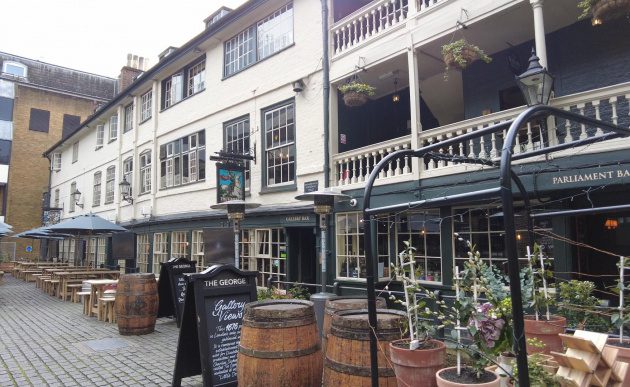
The George Inn
75 Borough High Street , London, SE1 1NH
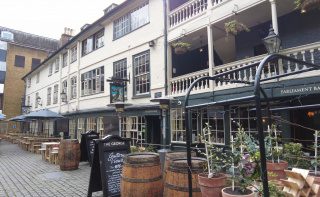
In the days before the introduction of railways the best way to travel around the country was by stage-coach. Coaching inns developed around the periphery of the City on the major roads that led out in each direction. They were typically constructed around a courtyard within which passengers could board or disembark. The building that surrounded the courtyard was usually galleried, containing rooms in much the same way as a modern hotel. The road that led to all points south was Borough High Street and until the 19th century the street was lined with coaching inns. The last survivor of the galleried coaching inns in London is the George Inn. You can learn more here in my video.
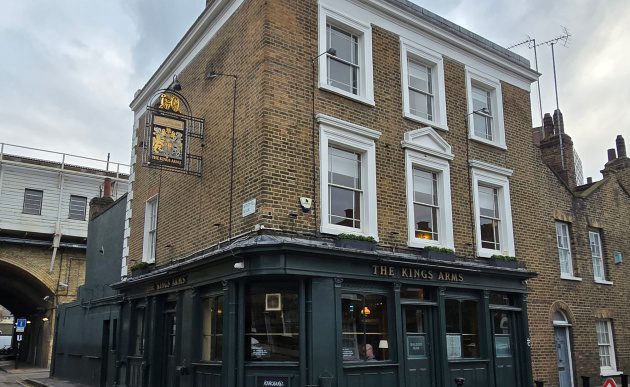
The King’s Arms
25 Roupell Street, Waterloo, London, SE1 8TB
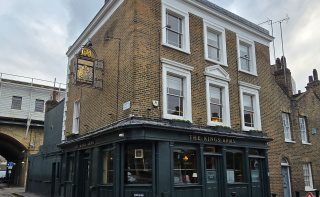
The King’s Arms is a local pub situated in Roupell Street at Lambeth. Roupell Street and the surrounding streets were developed in around 1830 by gold refiner John Palmer Roupell, and were each originally named after members of his family. They are now a conservation area, regularly used for making period film and TV programmes. The pub has a largely mid-20th century interior and is Grade II listed.

The Lord Clyde
27 Clennam Street, London, SE1 1ER
The Lord Clyde is named after the Scotsman Colin Campbell Clyde, a distinguished commander who rose from humble origins to the rank of Commander in Chief of the army. Lord Clyde died in 1863, when the first pub was opened on this site at Borough in South London. It was rebuilt by Trumans in 1913 with a splendid frontage featuring ceramic work, typical of the time, that remains in place. The popular local features an L-shaped bar surrounded by the front public room. To the rear of the bar is a smaller second public room.
West London

The Eight Bells
89 Fulham High Street, Fulham, SW6 3JS
Follow Fulham High Street in a southerly direction and the busy road veers slightly to the right as it becomes Putney Bridge Approach. But the High Street continues straight on as a minor side road until coming to a dead end in a car park. Until the 1880s the High Street continued up to the ancient, wooden Fulham Bridge. At the northern end of the bridge stood the Eight Bells pub. Its first licence was granted in 1629, making it the oldest tavern in Fulham, and it has had its current name since the 1750s. The old bridge was replaced in 1886 by Putney Bridge, on that different alignment, and traffic no longer passed the pub. The landlord sued the Metropolitan Board of Works and was awarded £1,000 compensation. In the 1880s the nearby Fulham Football Club used the pub as their changing room. The Eight Bells now has the feel of a cozy local. To my knowledge, it is one of only two pubs in London (at the time of writing) that serve poutine, a dish from Quebec.