John Stow (and Henry Machyn)
We can today gain some insight into the everyday life of Tudor London through two contemporary accounts written by men living in the city: John Stow and Henry Machyn.
Henry Machyn kept a diary between 1550 and 1563, one hundred and sixty-two folios in length, and apparently for his own pleasure. That was the period of political and religious turbulence during the reigns of Edward VI, Lady Jane Grey, Queen Mary and the beginning of Elizabeth’s reign. Machyn describes the changes of monarchs, insurrections, state visits, festivities, executions, punishments and – his particular speciality – funerals.
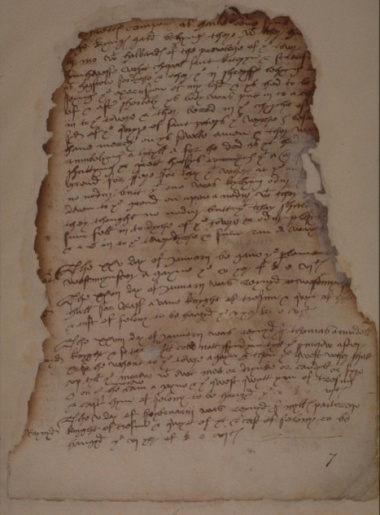
A surviving fragment of Henry Machyn’s diary held by the British Library.
Although Machyn describes many public events, there is little about himself in the diary. There is not much known about him other than he was a furnisher of funeral trappings, of the parish of Holy Trinity the Less, Queenhithe, who was probably born in the late 1490s and was a member of the Merchant Taylors livery company. He died in 1563, the year the diary ends, perhaps in the plague of that year.
His enthusiastic descriptions of certain Catholic practices have suggested that his sympathies remained broadly Catholic. He was evidently a bit of a gossip because there is a record of him being chastised in 1561 for passing on that a particular French preacher was “taken with a wench”. His punishment was to kneel throughout a sermon at St. Paul’s Cross before the Bishop of London and the French preacher, which was no doubt an embarrassing episode for him.
The language Machyn uses is in itself interesting and is probably a Tudor version of cockney, often dropping the letter ‘h’ (“alff” for half) but adding it where unnecessary (“harse” for arse, “behyng” for being).
Sadly the original manuscript of Machyn’s diary were partly destroyed in a fire in 1731, with the remains kept at the British Library. However, some of it was quoted by the London historian John Strype, who in 1697 had access to an original copy of the diary.

One of the best descriptions of Tudor London and contemporary events was provided by the historian John Stow. He was born in 1525, during the reign of Henry VIII and died in 1605 in that of King James I.
Stow was born in the parish of St. Michael Cornhill, into a London family of at least three generations. When he was young there was the Abbey of St. Clare outside of the city wall at Aldgate, whose Franciscan nuns were known as ‘Minoresses’. (The street is still called Minories). One of young John’s tasks was to bring home milk from their dairy. His father had a house at Austin Friars, Throgmorton Street, part of whose garden in about 1531 or 1532 was appropriated by Sir Thomas Cromwell to expand his own adjacent property.
Stow was the son and grandson of tailors and he was apprenticed to the family business. After completing his apprenticeship in 1549 Stow became a master tailor, by which time he was living at Aldgate. In 1549 he saw on his doorstep the execution of the bailiff of Romford.
Stow’s earliest literary publication was regarding the poet Geoffrey Chaucer, published in 1561 as The workes of Geffrey Chaucer, newly printed, with divers addicions whiche were never in printe before. Many years later, he also contributed material to Thomas Speght’s edition of the works of Geoffrey Chaucer, published in 1598. Stow supplied notes and material for Speght’s account of Chaucer, building on his own 1561 edition of Chaucer’s works.
During Stow’s lifetime there was an upsurge in the concept of England as a nation and a growing interest in its past history. While still working as a tailor, Stow collected books, which he used as reference material for his next account, A Summarie of Englysh Chronicles. It was published in 1561, in the early years of the reign of Queen Elizabeth. Eleven editions were published in Stow’s lifetime and during that period it became a standard work on the history of England. Its success prompted Stow, at about the age of forty, to leave his tailoring business and devote himself to historical research. In later editions of the book he also mentions encouragement from the Earl of Leicester.
Stow’s was not the only similar book at the time. In 1548 the printer Richard Grafton had published Edward Hall’s The Union of the Two Noble and Illustre Families of Lancastre and Yorke, otherwise known as Hall’s Chronicle. The year after the first publication of Stow’s book, Grafton published his own An abridgement of the Chronicles of England. Grafton followed that with several other similar works. Stow and Grafton became bitter rivals, mocking each other’s work and Stow responded in 1580 with The Chronicles of England, from Brute unto this present yeare of Christ.
One supporter of Stow’s work was Archbishop of Canterbury Matthew Parker, who was a student of antiquity. It was at Stow’s suggestion, and with his aid, that Parker paid for the printing of older histories by Matthew Paris, Matthew of Westminster, and Thomas Walsingham. Parker died in 1575 and Stow lost his principle patron.
Stow collected historical manuscripts relating to earlier London and English history. They frequently recorded events in pre-Reformation times and this led to a suspicion of his loyalties to the government, resulting in occasional visits from the authorities. In the 1560s he was reported to Queen Elizabeth’s Council as a suspicious character and was investigated by Edmund Grindal, Bishop of London.
While Stow competed with other authors in the history of England, there was no such competition regarding the history of London. Stow lived in the capital all his life and during the reign of Queen Elizabeth made a thorough study of his native city. A Survey of London was published in 1598 when he was over seventy years old. It chronicled both the city in its present state and its past. It was the first of its kind. In 1603 a second, revised edition was published.
That period was a time of continual change and rebuilding within London. Stow recorded each City ward in turn, describing the rapid change and growth of the capital during his lifetime. He noted how areas immediately outside the walls, that had been fields and grazing land where he bought milk as a boy, were being encroached on by “mean cottages and tenements, some with garden plots”. He took pride in the growing prosperity of the city and the number of grand buildings such as the livery company halls and Thomas Gresham’s new Royal Exchange.
The London of Stow’s time was in many ways the same as the older medieval city, with a bustling commercial centre, and with rich and poor living alongside each other. Many ancient buildings from as far back as the 11th and 12th centuries still survived, particularly the many parish churches, although the former monastic buildings were disappearing or finding new uses.
Stow also recorded what remains he discovered of previous times, noting the discovery of ancient structures below contemporary buildings that were found during building work. He wrote about Roman relics unearthed at Spitalfields. It was clear that the ground on which London was built, even by Tudor times, was somewhat higher than in the past and that remains of an older London were buried below.

The monument to John Stow in St. Andrew Undershaft church.
Stow’s work seems to have failed to provide him with prosperity. In 1604, at the age of seventy-nine, he was issued by King James with a Patent of Beggary, a licence to solicit for charitable contributions in recognition of his having “compiled and published diverse necessary books and Chronicles”.
John Stow died the following year on 5th April 1605. He was buried on 8th April in St. Andrew Undershaft church where his wife Elizabeth had a monument erected in the church. It is attributed to Nicholas Johnson, and made of Derbyshire marble and alabaster, showing her husband reading. If Stow died a pauper, it is unclear how Elizabeth funded the extravagant memorial. Its inscription includes the words: “Elizabetha Coniux, ut perpetuum sui amoris testimonium dolens.”, (translated as “Elizabeth, his wife, grieving, [erected this] as a perpetual testimony of her love”).
Elizabeth was Stow’s wife at the time of his death and he is known to have had three daughters: Mary, Joan and Julyan. However, the parish records of St. Andrew Undershaft include the burial in January 1580 of “Ann Stow, wiffe of John Stow”, so Elizabeth seems to have been his second wife.
By 1828 a regular commemoration was taking place in which a feather quill was placed in Stow’s hand on the monument at St. Andrew’s, giving the impression of him writing rather than reading. In 1905 the Merchant Taylor’s livery company had the monument restored. The commemoration appears to have lapsed but by 1914 had become an annual event. During the 1920s it became a larger ceremony, attended by the Lord Mayor. It is now organised by the Merchant Taylors and held every third year on a date close to the 5th April.
Sources include:
- John Stow ‘A Survey of London’ 1598 (edited by Antonia Fraser)
London People
Here are just a few of the people who have made their mark on London over the centuries.


